BMC Load & Terrain-Aware Range Prediction
About the project
This project is a European Union initiative between fleet companies aiming to fully convert their vehicles to hydro-electric trucks and BMC Trucks
In fleet management, optimizing fuel consumption and ensuring vehicle efficiency are crucial for reducing operational costs and maximizing productivity. For hydro-electric vehicles, there is a specific need for an HMI (Human-Machine Interface) that accurately monitors fuel levels and predicts remaining range based on the vehicle’s route, load, and driving conditions. Current solutions lack the precision and user-friendliness required for fleet managers to make informed decisions regarding fuel usage, route planning, and load management.
The goal is to design an HMI system that provides fleet operators with real-time insights and accurate fuel predictions, enabling proactive fuel management, minimizing downtime, and supporting cost-effective logistics operations.
SOLUTION
A range prediction solution was developed by taking into account the vehicle load and the slope of the route between distances. This technically feasible solution was integrated into the interface, enabling fleet managers to make fast and efficient decisions.
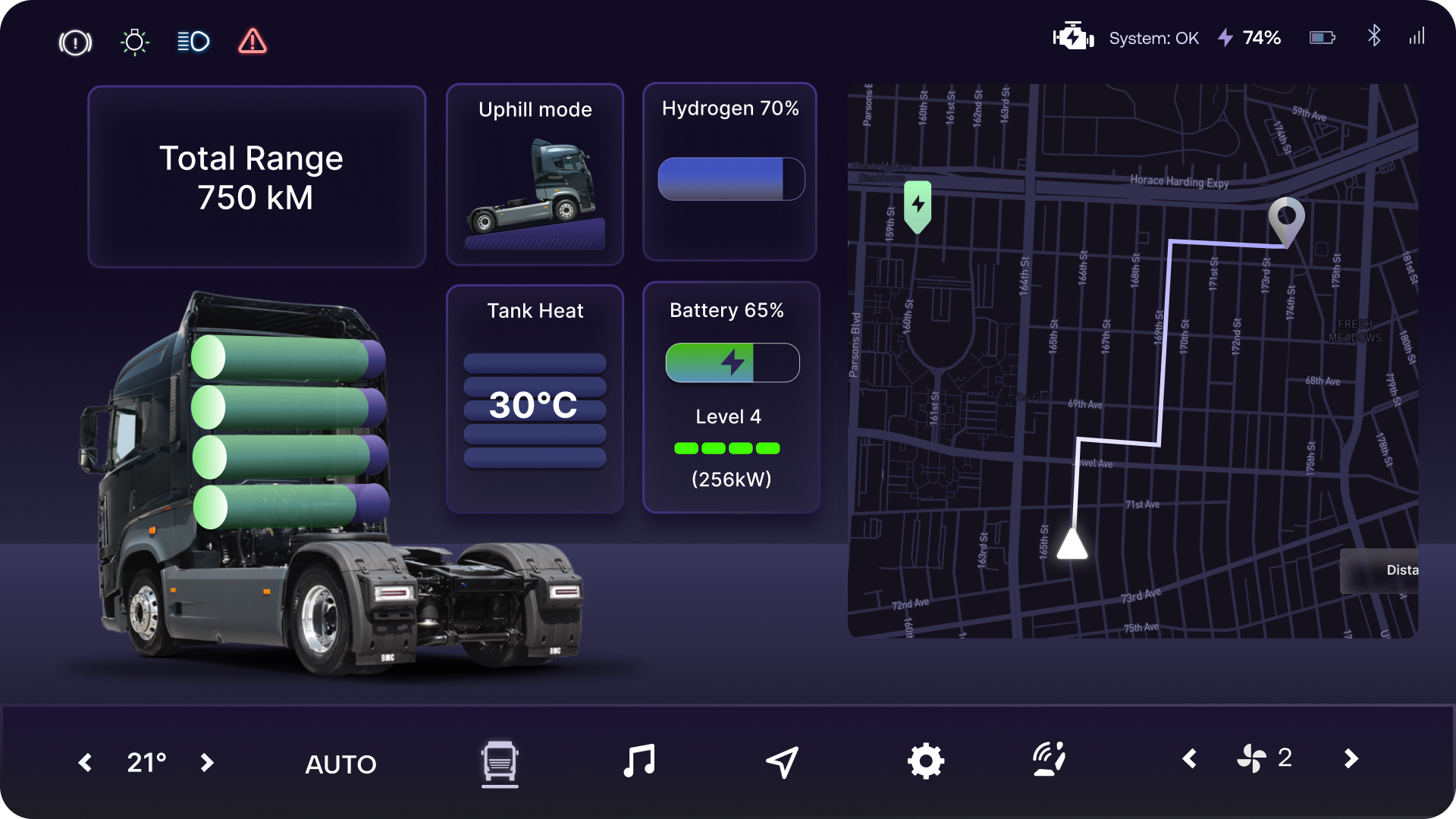
We also developed a main dashboard solution that allows real-time monitoring of the hydrogen tanks, which is crucial for fleet management.
MY ROLE
Conducting interviews with fleet managers, designing wireframes and designing UI interaction prototypes.
DURATION
5 months

When diesel trucks were converted into hydro-electric vehicles, traditional fleet planning logic stopped working.
Energy behavior became unpredictable due to:
Varying cargo loads
Terrain inclines
Early-stage nature of hydrogen infrastructure
Fleet managers could no longer confidently answer a simple
Which vehicle can safely complete which delivery?
In this project, I worked on a range prediction and planning interface that reframed “remaining fuel” into context-aware decision support.
By combining:
Vehicle weight
Route terrain profile
The system provided confidence-informed range estimates that helped logistics operators assign vehicles more safely and realistically, especially during early adoption of alternative energy fleets.
The solution was intentionally designed as a planning tool, not a promise, supporting operational decisions without over claiming accuracy.
The solution was intentionally designed as a planning tool, not a promise, supporting operational decisions without over claiming accuracy.
This interface was designed as a planning and monitoring aid, not as a guarantee of exact remaining range
Design Rationale - Visual Density & Dark UI
This interface was intentionally designed to be information-dense and visually subdued.
The target context is:
Professional fleet operation
Prolonged usage
Decision making under uncertainty
Key considerations
High information density allows experienced users to cross-reference critical variables without navigating between screens.
A dark visual theme reduces eye strain during long operational hours and increases contrast for alerts and route-based risk visualization.
Secondary system parameters (e.g. tank temperature, power output) are visible for expert awareness, while primary decisions are driven by range confidence and route context
The map-centric layout reflects how fleet decisions are actually made spatially, not numerically.
Real-time transcription and AI interactions distract users from participating fully in conversations.
The goal was not to simplify the system at the cost of accuracy, but to structure complexity into an interpretable decision layer.
Full case walkthrough available upon request (ugurgokus@gmail.com)

Back to Home

Ugur
Gokus
Home
BMC Load & Terrain-Aware Range Prediction
About the project
This project is a European Union initiative between fleet companies aiming to fully convert their vehicles to hydro-electric trucks and BMC Trucks
In fleet management, optimizing fuel consumption and ensuring vehicle efficiency are crucial for reducing operational costs and maximizing productivity. For hydro-electric vehicles, there is a specific need for an HMI (Human-Machine Interface) that accurately monitors fuel levels and predicts remaining range based on the vehicle’s route, load, and driving conditions. Current solutions lack the precision and user-friendliness required for fleet managers to make informed decisions regarding fuel usage, route planning, and load management.
The goal is to design an HMI system that provides fleet operators with real-time insights and accurate fuel predictions, enabling proactive fuel management, minimizing downtime, and supporting cost-effective logistics operations.
SOLUTION
A range prediction solution was developed by taking into account the vehicle load and the slope of the route between distances. This technically feasible solution was integrated into the interface, enabling fleet managers to make fast and efficient decisions.
We also developed a main dashboard solution that allows real-time monitoring of the hydrogen tanks, which is crucial for fleet management.
MY ROLE
Conducting interviews with fleet managers, designing wireframes and designing UI interaction prototypes.
DURATION
5 months

When diesel trucks were converted into hydro-electric vehicles, traditional fleet planning logic stopped working.
Energy behavior became unpredictable due to:
Varying cargo loads
Terrain inclines
Early-stage nature of hydrogen infrastructure
Fleet managers could no longer confidently answer a simple
Which vehicle can safely complete which delivery?
In this project, I worked on a range prediction and planning interface that reframed “remaining fuel” into context-aware decision support.
By combining:
Vehicle weight
Route terrain profile
The system provided confidence-informed range estimates that helped logistics operators assign vehicles more safely and realistically, especially during early adoption of alternative energy fleets.
The solution was intentionally designed as a planning tool, not a promise, supporting operational decisions without over claiming accuracy.
The solution was intentionally designed as a planning tool, not a promise, supporting operational decisions without over claiming accuracy.

This interface was designed as a planning and monitoring aid, not as a guarantee of exact remaining range
Design Rationale - Visual Density & Dark UI
This interface was intentionally designed to be information-dense and visually subdued.
The target context is:
Professional fleet operation
Prolonged usage
Decision making under uncertainty
Key considerations
High information density allows experienced users to cross-reference critical variables without navigating between screens.
A dark visual theme reduces eye strain during long operational hours and increases contrast for alerts and route-based risk visualization.
Secondary system parameters (e.g. tank temperature, power output) are visible for expert awareness, while primary decisions are driven by range confidence and route context
The map-centric layout reflects how fleet decisions are actually made spatially, not numerically.
Real-time transcription and AI interactions distract users from participating fully in conversations.
The goal was not to simplify the system at the cost of accuracy, but to structure complexity into an interpretable decision layer.
Full case walkthrough available upon request (ugurgokus@gmail.com)
Back to Home

Ugur
Gokus
Home
BMC Load & Terrain-Aware Range Prediction
About the project
This project is a European Union initiative between fleet companies aiming to fully convert their vehicles to hydro-electric trucks and BMC Trucks
In fleet management, optimizing fuel consumption and ensuring vehicle efficiency are crucial for reducing operational costs and maximizing productivity. For hydro-electric vehicles, there is a specific need for an HMI (Human-Machine Interface) that accurately monitors fuel levels and predicts remaining range based on the vehicle’s route, load, and driving conditions. Current solutions lack the precision and user-friendliness required for fleet managers to make informed decisions regarding fuel usage, route planning, and load management.
The goal is to design an HMI system that provides fleet operators with real-time insights and accurate fuel predictions, enabling proactive fuel management, minimizing downtime, and supporting cost-effective logistics operations.
SOLUTION
A range prediction solution was developed by taking into account the vehicle load and the slope of the route between distances. This technically feasible solution was integrated into the interface, enabling fleet managers to make fast and efficient decisions.
We also developed a main dashboard solution that allows real-time monitoring of the hydrogen tanks, which is crucial for fleet management.
MY ROLE
Conducting interviews with fleet managers, designing wireframes and designing UI interaction prototypes.
DURATION
5 months

When diesel trucks were converted into hydro-electric vehicles, traditional fleet planning logic stopped working.
Energy behavior became unpredictable due to:
Varying cargo loads
Terrain inclines
Early-stage nature of hydrogen infrastructure
Fleet managers could no longer confidently answer a simple
Which vehicle can safely complete which delivery?
In this project, I worked on a range prediction and planning interface that reframed “remaining fuel” into context-aware decision support.
By combining:
Vehicle weight
Route terrain profile
The system provided confidence-informed range estimates that helped logistics operators assign vehicles more safely and realistically, especially during early adoption of alternative energy fleets.
The solution was intentionally designed as a planning tool, not a promise, supporting operational decisions without over claiming accuracy.
The solution was intentionally designed as a planning tool, not a promise, supporting operational decisions without over claiming accuracy.
This interface was designed as a planning and monitoring aid, not as a guarantee of exact remaining range
Design Rationale - Visual Density & Dark UI
This interface was intentionally designed to be information-dense and visually subdued.
The target context is:
Professional fleet operation
Prolonged usage
Decision making under uncertainty
Key considerations
High information density allows experienced users to cross-reference critical variables without navigating between screens.
A dark visual theme reduces eye strain during long operational hours and increases contrast for alerts and route-based risk visualization.
Secondary system parameters (e.g. tank temperature, power output) are visible for expert awareness, while primary decisions are driven by range confidence and route context
The map-centric layout reflects how fleet decisions are actually made spatially, not numerically.
Real-time transcription and AI interactions distract users from participating fully in conversations.
The goal was not to simplify the system at the cost of accuracy, but to structure complexity into an interpretable decision layer.
Full case walkthrough available upon request (ugurgokus@gmail.com)
Back to Home

Ugur
Gokus
Home